
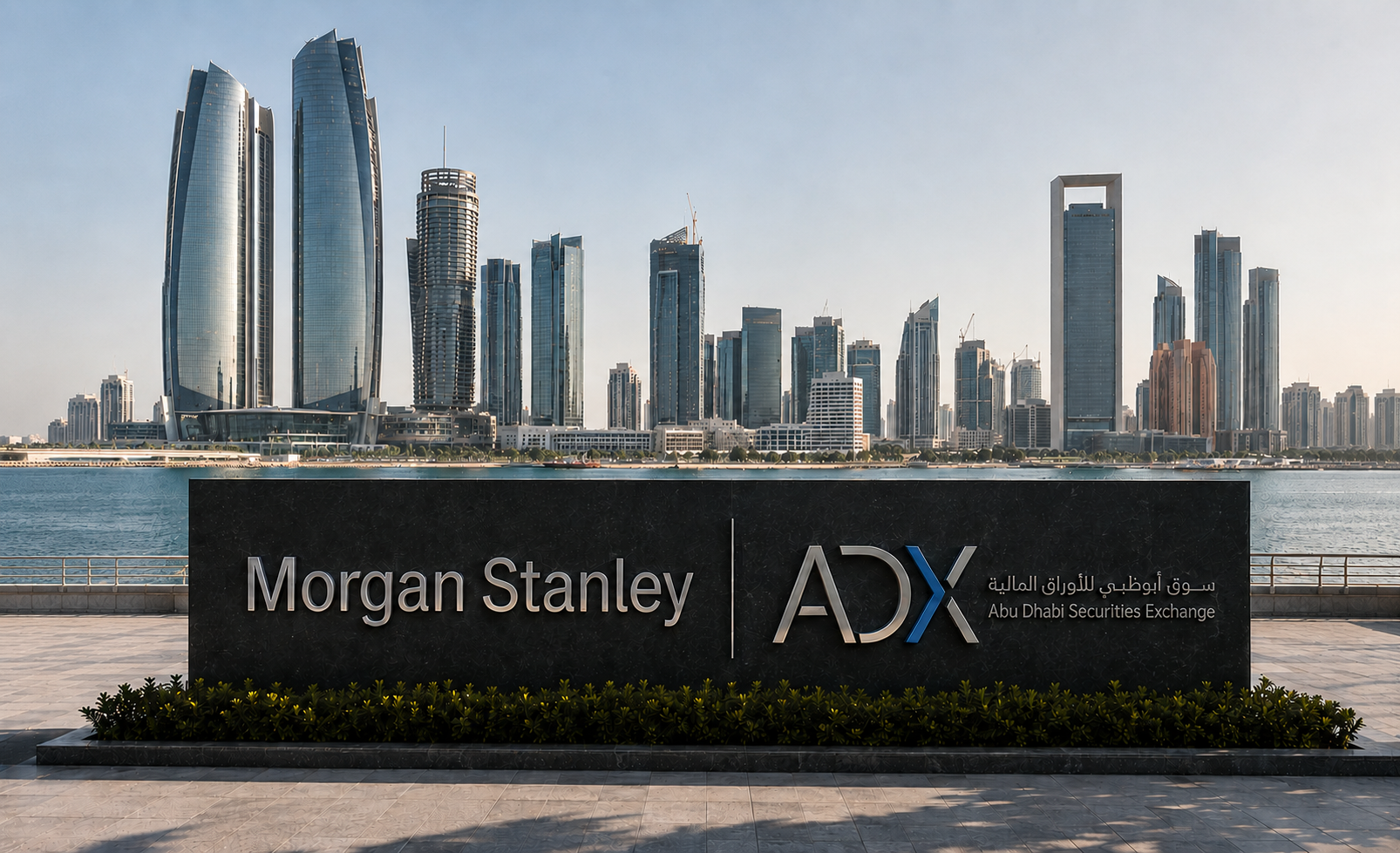
The Abu Dhabi Securities Exchange has entered a new phase of internationalization following Morgan Stanley’s appointment as the exchange’s first international remote trading member. The development is more than a symbolic partnership between a major Wall Street institution and one of the Gulf’s fastest-growing exchanges. It reflects a broader structural shift underway in global finance, where institutional investors are increasingly turning to the Gulf region for liquidity, diversification, infrastructure investment, and long-term economic growth.
Morgan Stanley’s remote trading membership enables the bank’s clients to access ADX-listed securities directly through its own global trading platform. This arrangement significantly improves execution speed, order management efficiency, and institutional access to UAE markets without requiring a physical trading presence inside the country. For large international asset managers, hedge funds, sovereign wealth entities, and pension funds, the model creates a far more streamlined route into regional equities and investment products.
Abu Dhabi’s Financial Markets Continue Their Rapid Expansion
The timing of the announcement aligns with a period of exceptional growth for Abu Dhabi’s capital markets. Foreign investor participation on ADX has accelerated sharply over the past two years as the UAE deepens its economic diversification agenda and expands its role in global finance. Trading activity from overseas investors rose substantially during the first quarter of 2026, with transaction values surpassing AED 85 billion, representing a significant year-over-year increase and underscoring growing institutional confidence in the market.
This momentum has been supported by several overlapping trends. Oil revenues continue to provide fiscal stability across the Gulf, yet governments throughout the region are simultaneously investing heavily in non-oil sectors such as artificial intelligence, logistics, fintech, renewable energy, healthcare, and digital infrastructure. Abu Dhabi in particular has aggressively positioned itself as a destination for global capital through regulatory modernization, sovereign-backed investment initiatives, and exchange reforms designed to attract international institutions.
ADX has also benefited from its inclusion in major global indices, which has naturally increased passive capital inflows from international funds tracking emerging and frontier markets. As global portfolio managers search for higher-growth regions with stable macroeconomic fundamentals, Gulf exchanges are becoming increasingly difficult to ignore.
Why Remote Trading Membership Matters
Remote trading membership may appear highly technical on the surface, but its strategic implications are considerable. Traditional cross-border trading often involves multiple intermediaries, fragmented execution systems, and operational friction that can discourage large-scale institutional participation. Direct market connectivity substantially simplifies that process.
For Morgan Stanley, the structure allows the bank to integrate ADX access directly into its existing institutional trading ecosystem. Clients can interact with UAE markets using familiar infrastructure, established compliance systems, and centralized execution capabilities. This reduces barriers to entry while improving transparency and operational control across the entire trade lifecycle.
For ADX, the partnership delivers something equally important: credibility within the global institutional finance ecosystem. When a major international investment bank establishes direct exchange connectivity, it signals to the broader market that the exchange has reached a level of maturity, liquidity, and regulatory sophistication capable of supporting international institutional activity at scale.
The move also strengthens Abu Dhabi’s ambitions to compete more aggressively with other international financial centers. While Dubai has traditionally dominated the regional financial narrative, Abu Dhabi has increasingly differentiated itself through sovereign-backed investment power, advanced market infrastructure, and targeted institutional partnerships.
The Gulf’s Rising Influence in Global Finance
Morgan Stanley’s integration into ADX comes amid a broader transformation in global capital allocation patterns. Institutional investors are gradually increasing exposure to Gulf economies as geopolitical fragmentation, elevated inflation pressures, and slowing growth in certain developed markets reshape investment strategies worldwide.
The Gulf Cooperation Council economies now represent some of the strongest fiscal positions globally, supported by robust sovereign balance sheets and substantial state-backed investment vehicles. Sovereign wealth funds from the region collectively manage trillions of dollars in assets and are actively deploying capital into technology, infrastructure, fintech, semiconductors, sports, and energy transition initiatives across multiple continents.
At the same time, the region itself is attracting increasing amounts of inbound capital. International banks, hedge funds, family offices, and fintech firms continue expanding operations across the UAE and Saudi Arabia, drawn by regulatory reforms, tax advantages, and rising institutional demand.
This evolving financial ecosystem is changing how global investors perceive Middle Eastern markets. What was once viewed primarily as an energy-driven region is increasingly being recognized as a sophisticated financial corridor connecting Asia, Europe, and Africa.
A Strategic Shift With Long-Term Consequences
The ADX-Morgan Stanley partnership ultimately represents more than an isolated market access agreement. It demonstrates how Gulf financial infrastructure is becoming more deeply embedded within global institutional trading networks. As more international banks establish direct exchange connectivity across the region, liquidity conditions are likely to improve further, creating a reinforcing cycle of participation, index inclusion, and foreign investment growth.
The UAE’s strategy appears increasingly focused on building globally interoperable financial markets capable of attracting long-duration institutional capital rather than short-term speculative flows. That distinction is critical because deeper institutional participation generally improves market resilience, enhances liquidity quality, and supports more sustainable capital formation over time.
For Morgan Stanley, the move strengthens its position in one of the world’s fastest-evolving financial regions. For Abu Dhabi, this marks another milestone in its efforts to establish itself as a central node in the future architecture of global finance.